


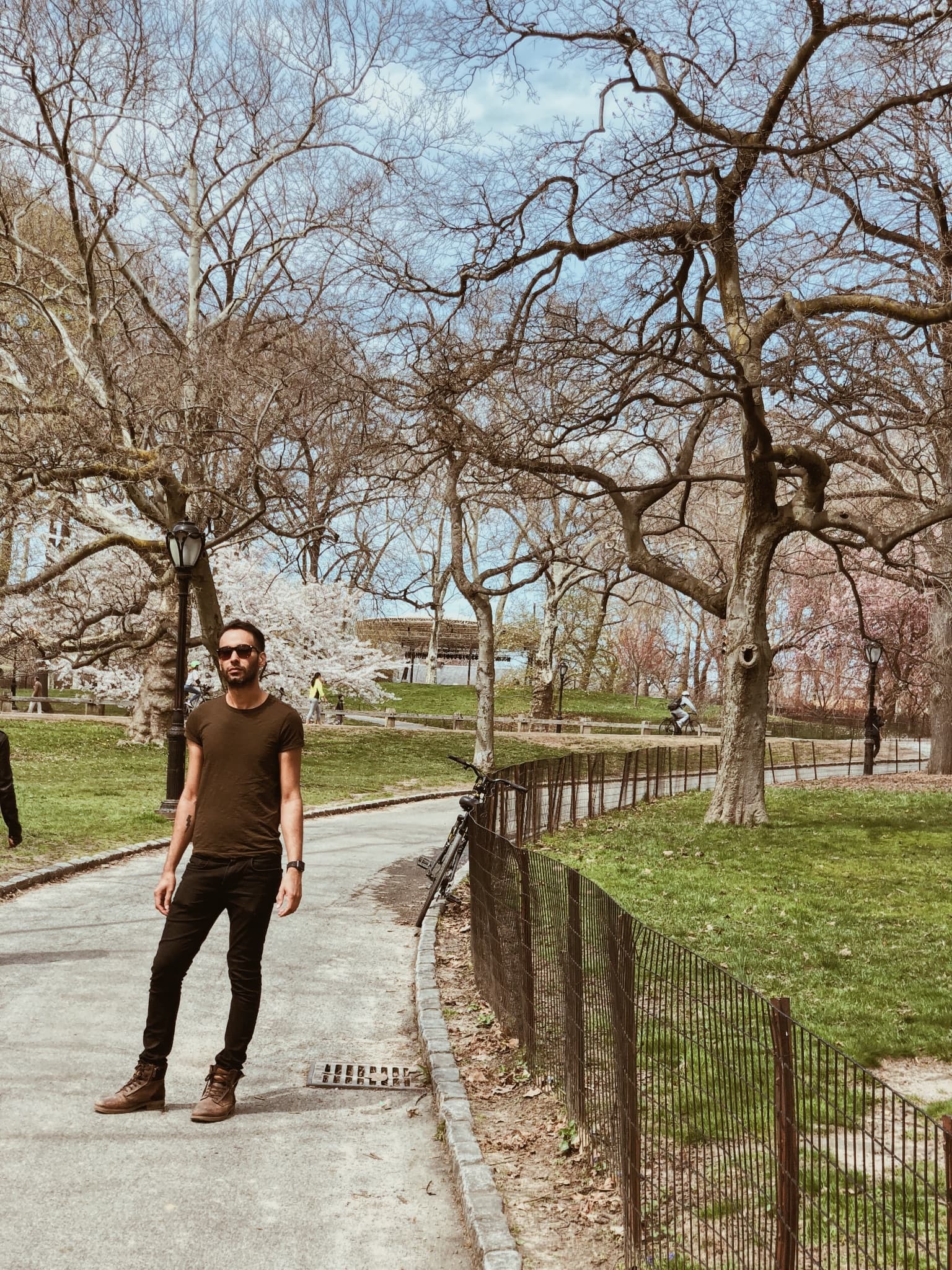
New York keeps a rectangle of quiet in the middle of the island and then pretends it is ordinary. It is not. You come in off a numbered street still half in traffic, and the park does the strange thing it was built to do: it makes the buildings feel farther away than they are. Elms meet overhead. Water sits where a meadow used to be argued over. Someone is always playing something you cannot quite name. Leave before you have seen everything. That is how you know you did it right.
A walker’s guide to Central Park
Olmsted and Vaux did not plant a park and hope. They built a sequence. Open lawn, then a formal walk, then water, then woods, then a fake castle on a real rock. The whole thing runs from 59th Street to 110th, Fifth Avenue to Central Park West, 843 acres, free to enter, open from 6 a.m. to 1 a.m. You will not cover it. You should not try.
The southern end holds the scenes people mean when they say Central Park. North of the Reservoir the park gets quieter, wilder, and easier to skip on a first visit. End to end without stopping is about 2.5 miles and close to an hour. The road that circles the park is a little over 6 miles. Neither number is the plan. The plan is three or four places, and the paths between them.
If you get turned around, look at a lamppost. The first two digits of the number on it are the cross street you are nearest. A post starting with 72 means you are around 72nd. That is the whole navigation system.
Arrive on the subway
A cab will drop you in a queue. The train drops you at a gate.
For a first visit, use Grand Army Plaza at Fifth Avenue and 59th. The N, R, and W stop there. You are next to the Plaza Hotel, and the park opens immediately onto a small pond and a stone bridge that photographers have worried over for decades. Walk in. Do not stand on the corner deciding.
Coming from the west side or from Midtown hotels nearer Columbus Circle, use the gate at 59th and Central Park West. The A, B, C, D, and 1 all land there. Horse carriages and pedicabs wait just outside. Walk past them. If you want a ride later, you can find one. You do not need one to see the park.
Short on time, or already uptown of 59th: the B or C to 72nd Street on Central Park West puts you almost on top of Strawberry Fields, with the terrace a short walk east.
The walk
Come in at the southeast corner and take the first bridge over the Pond. It is small, arched, and usually busy. Cross it anyway. The view back toward the buildings on 59th is the postcard, and it costs nothing but a minute.
Keep north until the path straightens. That straight stretch is the Mall, the only formal allée in the park, elms planted in two lines so the branches close over you. Benches face the walk. On a mild weekend someone will be dancing, someone will be sketching, and someone will be lying about how long they have lived here. The lower part of the Mall is lined with statues of writers. You can ignore the names. The trees are the attraction.
The Mall delivers you to Bethesda Terrace. Go down, not around. The passage underneath is the one interior in the park that feels finished: a tiled ceiling, stone stairs, a room that happens to have no walls. On the far side is the Angel of the Waters, the winged figure Emma Stebbins made for this exact spot in the 1860s. She is the only sculpture here that the park’s own designers ordered. Everything else was a gift.
The fountain under her is off. The Conservancy shut it down in early August for a restoration they expect to take about a year, and the terrace itself stays open. Sit on the steps. The design still works without the spray. It was always a room for people, not a plumbing display.
From the terrace, follow the water west for a few minutes to Bow Bridge. Cross to the middle and look back. Cast iron, lake, the west-side towers over the tree line. If you take one photograph, take it here, and take it facing the bridge rather than standing on it facing a stranger’s camera.
Strawberry Fields sits just inside the west wall near 72nd. The Imagine mosaic is usually ringed with flowers and at least one person playing. It is a memorial. Stand at the edge. Do not plant yourself in the circle for a portrait.
If the morning is still yours, walk north from the lake into the Ramble, the tangled wood between the water and the castle. Paths split on purpose. Stay near the shore until you can see the tower, then climb. Belvedere Castle is a folly from 1869, set on a knob of Manhattan bedrock, free to walk into. From the terrace you get Turtle Pond below you and the Great Lawn beyond it, and on a clear day the midtown skyline when you turn. It is also where the park’s weather is recorded, which is a better fact than it sounds. Leave by 81st and Central Park West if the natural history museum is next. Otherwise drop back south. You have done the park people mean.
That is a comfortable two hours with pauses. An hour is the pond bridge, the Mall, the terrace, Bow Bridge, and out. A longer day can add the running path around the Reservoir, the model-boat pond east of the Mall near 72nd, or the formal garden at Fifth Avenue between 104th and 106th. That garden, behind a tall iron gate that once belonged to a Vanderbilt house, is the part of the park that feels borrowed from somewhere else. It opens at 8 a.m. and closes at dusk. Most first-timers never get there, which is its own recommendation.
A few things that save the day
The zoo inside the park charges admission. Treat it as its own outing, not a glance on the way to the Mall.
Rowboats go out from the boathouse on the Lake, roughly April through November, first come. Weekday mornings are the only hour the wait is reasonable. The restaurant next door charges for the view. A coffee at the dock is the better spend.
Restrooms are real and limited. Many of the park’s facilities keep shorter hours than the gates, often closing in the late afternoon outside peak season. Go when you see one.
Sheep Meadow, west of the Mall, is for lying on the grass when it is open. It is not a field for games. The Great Lawn, north of the castle, is where the concerts and the softball games happen.
Morning belongs to runners and dogs. Midday belongs to everyone. Late light in warm months turns the terrace and the bridge the color people come back for, and the gates stay open until 1 a.m. After dark, keep to the drives and the southern landmarks if the park is new to you. The northern woods are a different walk, and not a first one at night.
A bike from a dock on the edge will show you more ground than a carriage, if you stay on the loop road and off the walking paths. The Conservancy, which has looked after the park since 1980, posts free tours and the week’s closures. Check that before you promise someone the fountain will be on.
Comments
Checking sign-in…
Loading comments…